A roguelite lives or dies on whether its floors feel like places. Ours had a rule from early on, written into the art guide after a mistake: one idea per floor. One floor-tile family, one light source that defines it, one colour that belongs to it, and a mechanic you can only meet there. Mixing wood and stone floor tiles "read as an ugly patchwork, tried and reverted"; an all-violet floor "looked muddy and monotone, tried and reverted". So each floor got one identity and committed to it.
They're also one story. Every floor is a deeper stretch of the same wound, burned by the First Flame on the night it fell, and every floor's dead are walking toward the Ember you carry, because they have nowhere else to go. At the bottom waits the Ashen Saint, keeper of the Hearth, who was the Flame all along: "Not dying. Tired. It had waited a very long time for someone to bring its pieces home."
Here they are, top to bottom.
I. The Kindlescar
Where the First Flame struck the earth. The top of the wound, and the crypt where every run starts: warm torches, red banners, light shafts with dust drifting through them, bats in the rafters. Skeletons, and the Bone Tyrant, Lord of the Kindlescar, a giant skeleton boss that leaps at you when you run, and in his last 30% tears himself open ("Bones Unbound") and sends bone eruptions racing down three lanes.
It's also where the toys are introduced: ember kegs that chain-explode, crates, flame vents on a timer, spike traps. Since the overnight sprint it has its own puzzle room (light the braziers in the order the skull piles count, before they gutter), a cracked wall hiding the Shadow of the Bone Tyrant on a hoard, and two new enemies. One of them started as Bone Hounds and became Ossuary Spiders the next day.
undefined when you were far away, and he'd stand there forever.II. The Ashen Archive
Every book a pyre. A burned library run by a cult. The trick of this floor is the colour: warm wall torches against violet witchfire braziers. The enemies are the cult: kindlings that run at you and fuse like bombs, brutes that telegraph a charge down a lane and stun themselves on walls, and cultists who ward their allies in purple bubbles and blink away when you close in.
Its boss, the Hollow Archmage, throws volleys you can cut out of the air, lays rune fields, fires a nova ring you have to roll through, and sweeps rotating beams that the pillars block. Her final phase sets the archive burning. It was the first floor the playtest loved outright ("loved floor II", says the changelog).
III. The Hollow Barrows
Here lie the Ember Knights. An underground graveyard of the knights who came before you, built from the KayKit Halloween pack. This is the cold floor: blue torches and braziers, warm lantern posts for contrast, and a drifting ground fog. (The fog was going to be particles; point sprites near the floor got clipped into hard-edged squares, so it became one flat sheet of animated noise.)
Everything here is a rhyme with you. Hollow Knights use your own model and your own three-hit combo, raise a shield, dodge-roll out of your swing, and parry. Wraiths are phased until fire reveals them. Living graves keep raising skeletons until you smash them. And the Lightless Crypt is pitch dark until you light it lantern by lantern; you do half damage until the lanterns burn.
The Hollow King is our favourite boss idea in the game. He fights with your moveset, scaled up, and at half health he steals one of your boons and uses it against you. There's a table in the code of what each boon does in his hands. Steal Searing Edge and his strikes leave cold fire on the ground; steal your flask and he carries one, and you have to break his drink with a heavy blow. He steals a second at 25% and makes a last stand at 15%.
IV. The Sunken Forge
Where the Ember was made. The design doc called it "a forge the size of a city, half-drowned in its own lava", and it's the first floor where fire stops being the answer, because the forge's creatures are made of it. The light comes from below. The layout isn't a corridor: a hub, the Great Forge, with three wings that each break one seal on the boss gate, in any order.
The lava took four attempts and is a story of its own, told in part 5. The creatures came out of the same night. When the playtest met the Cinderlings, molten slimes that hop, leap and split in two, the note was "more of that", and so came the Cinder Crawler, a molten-rock spider with six legs on procedural two-bone IK and a tripod gait, and Magma Eels that live in the lava and only surface to spit.
Then the toys: falling rocks, rolling boulders, trip-hammers that pound two lanes across the Great Forge on a rhythm, and the Anvil Choir, a Simon Says puzzle where a brazier flares toward each anvil as it sings and you strike them back in order.
And the boss. The Forge Heart is a colossal procedural smith rising out of a lava pool. Its fist slams stick in the floor, which is your opening, and blows on the fists fill its posture: break it and the colossus falls forward onto the arena edge with its heart bare for a few seconds (part 11). In phase 2 it breathes fire and the cavern collapses; in phase 3 its chest bursts open, chains drag you toward the pool, and it slams its bare heart down. When it dies, every lava channel on the floor cools to black stone.
V. The Drowned Cathedral
Below the forge, a cathedral the sea swallowed. Cold teal light through broken stained glass, waterfalls, a bell tolling in the quiet. Floodwater covers everything: it slows you, it speeds up the Drowned, it ripples and splashes, and it drains when the boss dies.
The floor's set piece is the Tide Gallery, a Crash Bandicoot gauntlet: breakers roll down the long hall in lanes on a beat and you time your way north between them. The first version of those waves didn't survive the playtest. The note was blunt, and the Floor V team rebuilt them as real breakers.
Its enemies are all water things: the Drowned (they lurch, chop, and burst on death), Bell Wardens with a toll that stuns, Lampreys hidden under the surface, Abyssal Jellies that split, and Choir Wraiths whose homing notes you can roll through, cut, or break with a bell. The boss is the Mother of Tides, a hooded saint with a broken stained-glass halo and pinned palms that are her weak points.
VI. The Shattered Spire
Up instead of down: a storm-wrapped ruin above a cloud sea. This floor's idea is the ground itself. Abyss pits (fall and you take damage and come back on the last safe stone; enemies just die), tiles that crumble behind you, wind gusts that push, lightning strikes with a telegraph, and Crash-style ball-lightning rollers. The Crumbling Gallery is a chase: the floor falls away and you run.
The boss, the Storm Seraph, is six-winged and hovers off the edge where you can barely touch it, until it dives and lands and you can. In phase 3 the platform's sides fall away. Its first version could be reached too easily, so after the second playtest it stays out of reach except during windows you earn.
VII. The Hearth of Origins
The last floor: obsidian halls veined with gold that pulse from the hearth, and shards of black glass drifting in the void. It's a floor about memory. The Hall of Echoes is a gauntlet of spectral echoes of the first three bosses, one after another. Memory stains on the floor show ghost knights replaying their deaths and last words. The Hollow Mirror replays your last three actions back at you, even your flask. A secret wall hides the Ashen Twin, a black-glass copy of whichever hero you're playing.
And the Ember Run: a Void Tide of black glass chases you down a long causeway, with eight glass crates to smash on the way for a bonus.
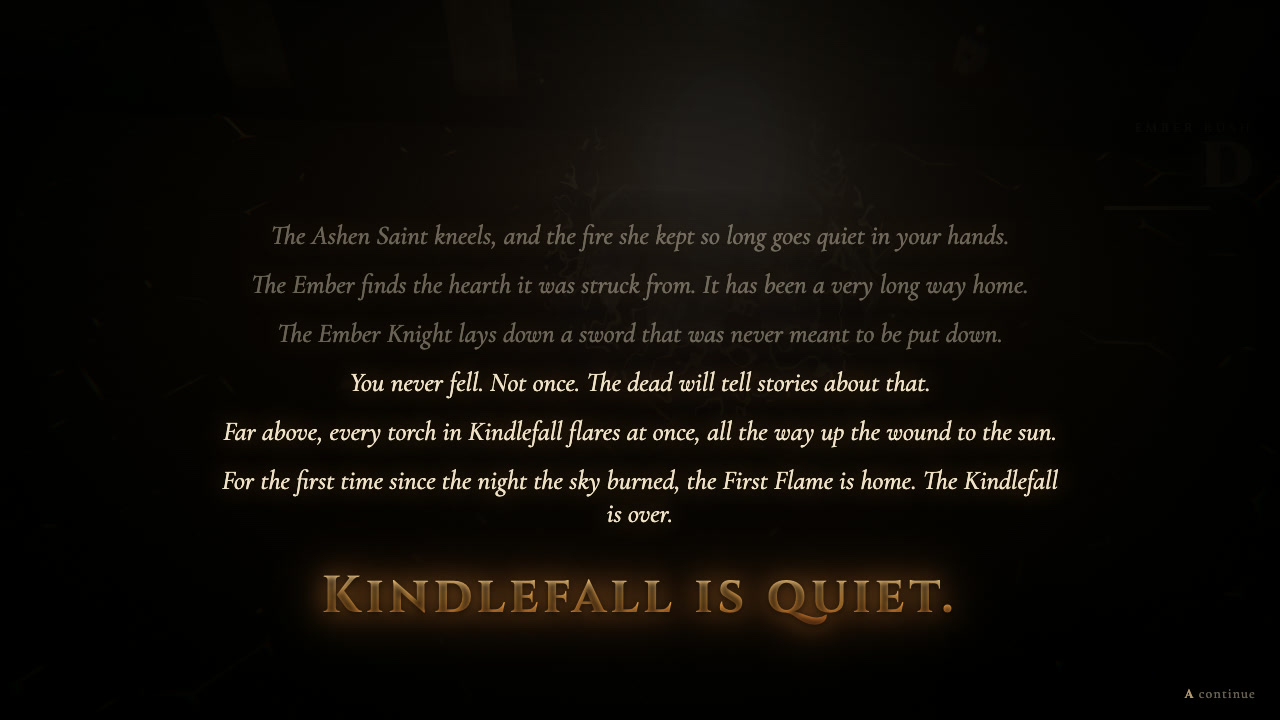
The final boss is the First Flame, a hooded saint of black glass with a burning halo. Phase 1 is sunlances, glass rain and a halo nova; in phase 2 the arena's rim falls into the void and phantoms of the first three bosses join in; in phase 3 the shell shatters. When it dies, the Flame unravels into a river of light, the hearth ignites and the void recedes. Then an epilogue that remembers your run, the word KINDLEFALL alone on the screen, and the main menu.
What every floor shares
A floor is more than its rooms, and the overnight sprint gave every floor the same scaffolding: a title card on arrival, its own score and ambience bed, a secret wall that sounds hollow when you hit it, fog gates over every boss door, a minimap with fog of war, a vault before the boss, a guardian with posture to break, and a split time against your best. Each floor is one object in a data file (floors.js for I to IV, a content module for V to VII), so a new floor is mostly data plus the one mechanic that makes it itself.